Building Maintenance Management: From Asset Register to Contractor Control
Building maintenance management is not just about fixing elevators, chillers, pumps or electrical panels after they fail. It is the operating system behind a safe, reliable and cost-controlled building: asset registers, preventive maintenance, service requests, contractor control, maintenance KPIs, dashboards and clear decision-making. If these basics are missing, even the best CMMS or AI tool will only digitize chaos.
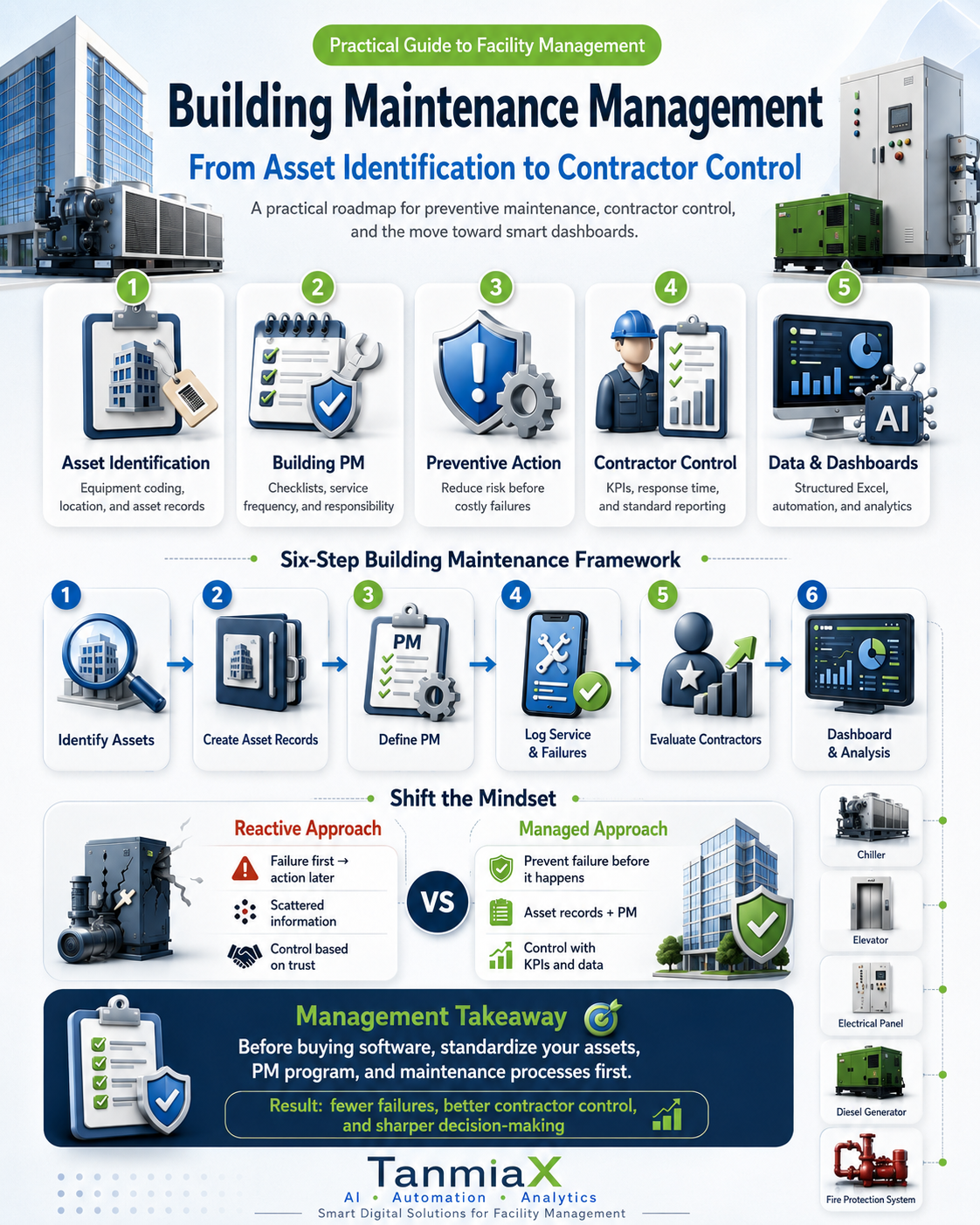
The real problem in building maintenance management
Many buildings look operational from the outside. The elevators run, the HVAC system works most days, the generator is tested occasionally and the contractor sends a short report. However, under the surface, there may be no structured asset register, no reliable preventive maintenance program, no standard service history and no real contractor performance data.
That is the hidden weakness in building maintenance management. The problem is not always the lack of software. In many facilities, the deeper problem is the lack of a management system. If you buy software before defining assets, responsibilities, PM tasks and reporting rules, you simply move the same confusion into a digital platform.
Assets are not properly identified
Managers may know the major systems, but not the exact equipment list, location, model, capacity, service history, failure pattern or responsible contractor.
PM exists only as a label
Some teams say they have PM, but there is no written checklist, frequency, acceptance criteria, evidence or follow-up action.
Contractors are controlled emotionally
Contractor performance is judged by trust, urgency or complaints instead of response time, repeat failures, overdue tasks and quality records.
Excel is used without discipline
A spreadsheet is useful only when it has a stable structure, one version of truth and enough fields to support management decisions.
What building maintenance management actually means
Building maintenance management is the organized process of keeping building assets safe, functional, efficient and cost-effective through planning, inspection, preventive maintenance, corrective repairs, documentation, contractor control and performance reporting. In other words, it turns maintenance from a reactive technical activity into a managed operating process.
This matters because buildings are not passive structures. Hotels, hospitals, malls, offices, residential towers and commercial complexes depend on mechanical, electrical, plumbing, safety, vertical transportation, security and digital systems. If these systems fail, the impact can hit safety, comfort, business continuity, reputation and cost.
International facility management guidance also treats facility management as a discipline connected to functionality, comfort, safety, efficiency and the built environment. For broader context, you can review the International Facility Management Association’s overview of what facility management is and ISO’s page for ISO 41001 facility management systems.
Reactive repairs vs. preventive maintenance
Reactive repair means acting after something fails. The elevator stops, the chiller trips, a pump leaks, the fire alarm panel shows a fault or the generator refuses to start. Then the team starts looking for a contractor, a spare part, a budget approval and a quick fix.
Preventive maintenance works differently. It defines what must be inspected, cleaned, tested, adjusted or replaced before failure. Therefore, instead of waiting for breakdowns, the team manages risk earlier and more deliberately.
Why asset management comes before software
A CMMS, dashboard or AI assistant cannot magically know what assets you have, where they are installed, how critical they are or what PM checklist is suitable. First, you need asset data and workflow discipline. Then technology can make that system faster, more transparent and more scalable.
Building maintenance management starts with an asset register
The first practical step in building maintenance management is to create a building asset register. This is a structured list of important assets, systems and equipment that need maintenance, inspection, service, compliance checks or contractor support.
For a large building, the asset register should include HVAC equipment, elevators, pumps, electrical panels, generators, UPS systems, fire alarm and firefighting systems, access control, CCTV, plumbing systems, water tanks, boilers, cooling towers, BMS components and critical rooms such as server rooms or control rooms.
What should an asset record include?
| Field | Why it matters | Example |
|---|---|---|
| Asset code | Removes ambiguity from reports and work orders. | HVAC-CH-001 |
| Asset name | Defines what the equipment is. | Main chiller no. 1 |
| Location | Helps technicians and contractors find it quickly. | Roof plant room |
| Brand, model and serial number | Supports spare parts, warranty and troubleshooting. | Brand / model / serial |
| Capacity and technical data | Improves maintenance planning and replacement decisions. | Cooling capacity, flow, voltage |
| Criticality level | Shows which assets deserve priority. | High / Medium / Low |
| Responsible contractor | Clarifies ownership and accountability. | Elevator service provider |
| PM frequency | Connects the asset to the maintenance plan. | Monthly, quarterly, annual |
| Last and next service date | Shows overdue and upcoming work. | Last: 2026-06-01 / Next: 2026-07-01 |
| Failure and cost history | Supports repair-or-replace decisions. | 3 failures in 6 months |
Which assets should be prioritized first?
You do not need to document every small item on day one. Start with assets where failure creates safety risk, business interruption, high cost, user dissatisfaction, compliance exposure or long lead-time spare parts. In most buildings, this means elevators, fire systems, emergency power, HVAC, critical pumps, electrical panels, security systems and assets with repeated failures.
Preventive maintenance in building maintenance management
Preventive maintenance, often called PM, is one of the most searched and misunderstood terms in facility operations. In building maintenance management, PM means planned activities performed before failure to reduce breakdowns, emergency costs and service disruption.
However, PM is not a casual visit by a technician. It must be written, repeatable and measurable. A real PM program defines the task, frequency, responsible person, required evidence, acceptance criteria and follow-up action if an abnormal condition is found.
Typical preventive maintenance tasks by asset type
| Asset type | Example PM activities | Management value |
|---|---|---|
| Chillers and HVAC | Check pressure, temperature, filters, coils, oil level, alarms, leakage and energy indicators. | Reduces comfort complaints, energy waste and major breakdowns. |
| Generators | Start test, battery check, fuel level, oil level, filters, control panel status and load test. | Improves emergency power readiness. |
| Electrical panels | Inspect connections, heat signs, dust, breakers, protection devices and abnormal smell or noise. | Reduces fire, outage and safety risks. |
| Pumps | Check vibration, noise, leakage, pressure, motor current, coupling and lubrication. | Finds early signs of mechanical or hydraulic problems. |
| Fire alarm systems | Test detectors, panels, batteries, alarms, fault history and zones. | Protects life safety and compliance readiness. |
| Elevators | Inspect doors, leveling, ride quality, error history, safety circuits and service records. | Improves safety, reliability and user experience. |
PM checklist quality matters
A weak checklist says “service completed.” A useful checklist asks for measurable observations: pressure, temperature, current, fault code, condition, photo, technician name, next action and approval. Therefore, the quality of the checklist directly affects the quality of building maintenance management.
Risk, frequency and responsibility
Every PM task should be linked to risk, frequency and responsibility. High-risk assets need tighter control. Low-risk assets can have simpler routines. Moreover, each task needs an owner for execution and another person or role for review when quality matters.
Contractor control in building maintenance management
Contractors are essential in most buildings. Elevators, HVAC, generators, firefighting systems, BMS, access control and electrical systems often depend on specialized vendors. However, contractor dependency becomes dangerous when the building owner has no data, no checklist and no performance measurement.
Good contractor control does not mean micromanaging technicians. It means defining service scope, response expectations, report format, PM checklist, escalation rules and maintenance KPIs. Without this, the contractor may attend the site but still deliver poor maintenance outcomes.
Common weakness in maintenance contracts
Many maintenance contracts say “monthly service” or “maintenance support” without defining the actual tasks, evidence, acceptance criteria or consequences of repeated failure. That language is too weak. A contractor can technically attend the building and still leave no useful management data behind.
Essential KPIs for maintenance contractor performance
PM on-time completion
Percentage of scheduled PM tasks completed within the planned period.
Response time
Average time between service request and contractor response.
Repair time
Average time needed to restore the asset or close the job.
Repeat failures
Number of repeated issues on the same asset or system.
Rework rate
Jobs that had to be reopened because the first repair was incomplete.
Report quality
Completeness of service records, photos, parts used and next actions.
What a contractor report should include
- Date and time of attendance
- Technician name and company
- Asset code and location
- Description of work performed
- Condition before service
- Parts used or replaced
- Defects found and recommended actions
- Final asset condition
- Photos, readings or test evidence where needed
- Approval by the building representative
Excel, CMMS and dashboards for building maintenance management
Excel is not the enemy. A bad spreadsheet is. For small or early-stage facilities, a well-structured Excel file can be a realistic starting point for building maintenance management. But it must have one owner, one version, consistent fields and regular updates.
The danger is false confidence. If the spreadsheet is incomplete, scattered across different users, missing asset codes or not updated after work is done, it creates the illusion of control. In reality, management decisions are still based on memory and guesswork.
Minimum fields for a maintenance spreadsheet
| Category | Minimum fields |
|---|---|
| Asset data | Asset code, asset name, category, location, criticality, contractor |
| PM plan | Task type, PM frequency, last service, next service, responsible person |
| Work history | Failure description, action taken, parts used, cost, closure status |
| Contractor control | Response time, repair time, rework, report quality, approval |
| Management reporting | Overdue PM, open requests, repeat failures, high-cost assets, monthly trend |
When to move from Excel to CMMS or dashboard
Move beyond Excel when service requests start getting lost, PM tasks become overdue, multiple contractors are involved, photos and documents need to be stored, approvals are required, or management needs a live view of asset condition, cost and contractor performance.
A CMMS can centralize work orders, preventive maintenance schedules, maintenance history, inventory, contractor tasks and notifications. A dashboard adds executive visibility by showing KPIs, overdue tasks, recurring failures, cost trends and risk areas. In more advanced cases, automation and AI can classify requests, trigger reminders, detect patterns and support repair-or-replace decisions.
Automation and AI in building maintenance management
Technology becomes valuable only when the operating problem is clear. A beautiful dashboard cannot fix missing asset codes. A chatbot cannot manage maintenance if service categories are undefined. AI cannot predict failures if maintenance history is incomplete. Therefore, digital tools should come after basic maintenance data and workflows are designed.
What dashboards solve
A maintenance dashboard gives managers a factual picture of the building. Instead of asking “what happened this month?”, they can see overdue PM tasks, open service requests, top failing assets, contractor delays, monthly costs, repeat failures and urgent risks.
How chatbots and smart CRM help
In hotels, hospitals, malls and residential complexes, requests come from many users: guests, tenants, staff, residents and operators. A chatbot or smart form can register the request, classify it, issue a tracking number, assign it to the right team and update the requester. A smart CRM can then keep the service history and communication trail in one place.
Where AI can add value
When enough clean data exists, AI can support building maintenance management by identifying recurring failures, grouping similar requests, detecting abnormal cost patterns, prioritizing urgent work, summarizing contractor reports and helping managers decide whether an asset should be repaired, redesigned or replaced.
Practical building maintenance management checklist
The following checklist is designed for facility managers, hotel operators, hospital engineering teams, mall managers, residential complex managers and building owners who need a practical starting point.
Asset register checklist
- Have all critical building assets been listed?
- Does each asset have a unique asset code?
- Is the exact location of each asset recorded?
- Are brand, model, capacity and serial number captured where available?
- Is the responsible contractor or internal owner defined?
- Has criticality been assigned to important assets?
- Can the team see failure history and last service date?
Preventive maintenance checklist
- Does each critical asset have a PM plan?
- Is the PM frequency clear: weekly, monthly, quarterly or annual?
- Is there a written checklist for each PM task?
- Is the person responsible for execution defined?
- Is the person responsible for review or approval defined?
- Are overdue PM tasks reported every month?
- Are repeat failures reviewed after PM?
Contractor control checklist
- Does the contractor contract include clear checklists?
- Is response time recorded?
- Is repair time recorded?
- Are parts and materials recorded?
- Are incomplete jobs or rework tracked?
- Is contractor performance reviewed monthly?
- Is contract renewal based on data, not only relationships?
| Area | Weak condition | Target condition | Recommended tool |
|---|---|---|---|
| Asset identification | Equipment is known verbally. | Every critical asset has a code and record. | Structured Excel or CMMS |
| PM | Service is irregular and vague. | Checklist, frequency and owner are clear. | PM calendar and dashboard |
| Contractors | Control is based on trust or pressure. | Control is based on KPIs and reports. | Monthly contractor scorecard |
| Failures | Only emergencies are remembered. | All failures are recorded and analyzed. | Service request system |
| Costs | Costs are general and unclear. | Costs are linked to assets and contractors. | Maintenance cost dashboard |
| Reporting | Reports are verbal or fragmented. | Monthly management report exists. | Executive maintenance dashboard |
Common mistakes in building maintenance management
Starting with software before the system
This is the classic expensive mistake. A facility buys CMMS software but does not have reliable asset data, PM tasks, contractor rules or reporting ownership. The software then becomes an empty shell or a digital dumping ground.
Using PM as a decorative term
If there is no checklist, frequency, evidence, responsibility and follow-up action, it is not preventive maintenance. It is a vague intention.
Trusting contractors without data
Trust is useful, but it is not a control system. Contractor control needs KPIs, service records, repeat failure analysis and monthly review.
Ignoring small failures
Small failures often reveal the early pattern of bigger problems. If small issues are not recorded, the organization loses its chance to see the trend.
Confusing technical reports with management reports
A technical report tells what was done. A management report tells what decisions are needed: which assets are risky, which contractor is weak, which costs are rising and which PM tasks are overdue.
Roadmap for implementing building maintenance management
A strong building maintenance management system does not need to start big. It needs to start correctly. The goal is to build enough structure to make maintenance visible, measurable and improvable.
Step 1: Capture the current reality
Collect the existing asset lists, contractor contracts, service reports, breakdown history, cost records and PM schedules. Do not try to make everything perfect at first. The goal is to see what exists and what is missing.
Step 2: Build the critical asset register
Start with high-risk and high-cost assets. Give each one a code, location, owner, contractor and criticality level. This becomes the foundation for every work order, PM task and management report.
Step 3: Design the first PM program
For each critical asset type, define the PM tasks, frequency, responsible person, checklist and evidence. Ask contractors for input, but do not accept generic checklists without review.
Step 4: Standardize contractor reporting
Define the report format, required photos, readings, parts used, defects found, recommendations and approval process. Then measure contractor performance monthly.
Step 5: Build a management dashboard
Once data starts flowing, build a simple dashboard for PM compliance, overdue work, open requests, repeat failures, contractor performance and maintenance costs. This is where management visibility begins.
Step 6: Add automation and AI where it makes sense
After the basics are stable, TanmiaX can help design dashboards, service request workflows, smart CRM, chatbot-based request registration, contractor performance analytics and AI-supported maintenance insights.
FAQ about building maintenance management
What is building maintenance management?
Building maintenance management is the structured process of managing assets, preventive maintenance, corrective work, contractor performance, costs and service requests so the building remains safe, reliable and cost-effective.
What is preventive maintenance in buildings?
Preventive maintenance, or PM, means scheduled inspections, servicing, testing, cleaning, adjustment and replacement tasks performed before a failure occurs. It reduces emergency repairs and improves asset reliability.
Do I need a CMMS before creating an asset register?
No. A CMMS is useful only when your assets, locations, checklists, responsibilities and maintenance workflow are defined. Start with an asset register and PM structure, then move to CMMS, dashboards or automation.
How should maintenance contractors be measured?
Contractors should be measured with KPIs such as on-time PM completion, response time, repair time, repeat failures, quality of reports, rework, extra costs and user satisfaction.
Can Excel be used for building maintenance management?
Yes, as a starting point. It must have a consistent structure: asset code, location, PM frequency, contractor, last service, next service, status, cost and work history. It becomes weak when assets, users and workflows scale.
When should a building move from Excel to CMMS or a dashboard?
Move beyond Excel when service requests are missed, PM tasks become overdue, contractor reports are inconsistent, multiple files exist, management needs real-time visibility, or you need reminders, forms, photos and automated workflows.
How can AI help building maintenance management?
AI can classify service requests, detect recurring failures, analyze contractor performance, forecast maintenance risks and support decision-making. However, AI needs clean asset, work order and maintenance history data to be reliable.
Conclusion: fix the maintenance system before buying more tools
Building maintenance management starts with knowing what assets you have. Then it moves to asset records, preventive maintenance, contractor KPIs, structured reporting, dashboards, automation and eventually AI. Skip the foundation and every digital tool becomes weaker.
If your building still depends on memory, scattered WhatsApp messages, vague contractor reports or disconnected Excel files, the problem is not just technical. It is managerial. The solution is to turn maintenance into a visible, measurable and continuously improved system.
For hotels, hospitals, malls, offices and large residential complexes, this is not optional. Poor maintenance hides cost, risk and dissatisfaction until it becomes a crisis. Professional building maintenance management gives you control before the crisis arrives.