Hospital FMEA Risk Assessment: A Practical HFMEA Guide with Forms and Examples
FMEA—and its healthcare-specific adaptation, HFMEA—helps hospitals, clinics, medical centers, and laboratories identify vulnerable process steps before an error reaches a patient. This guide explains the method, scoring, forms, KPIs, implementation roadmap, and a completed example.
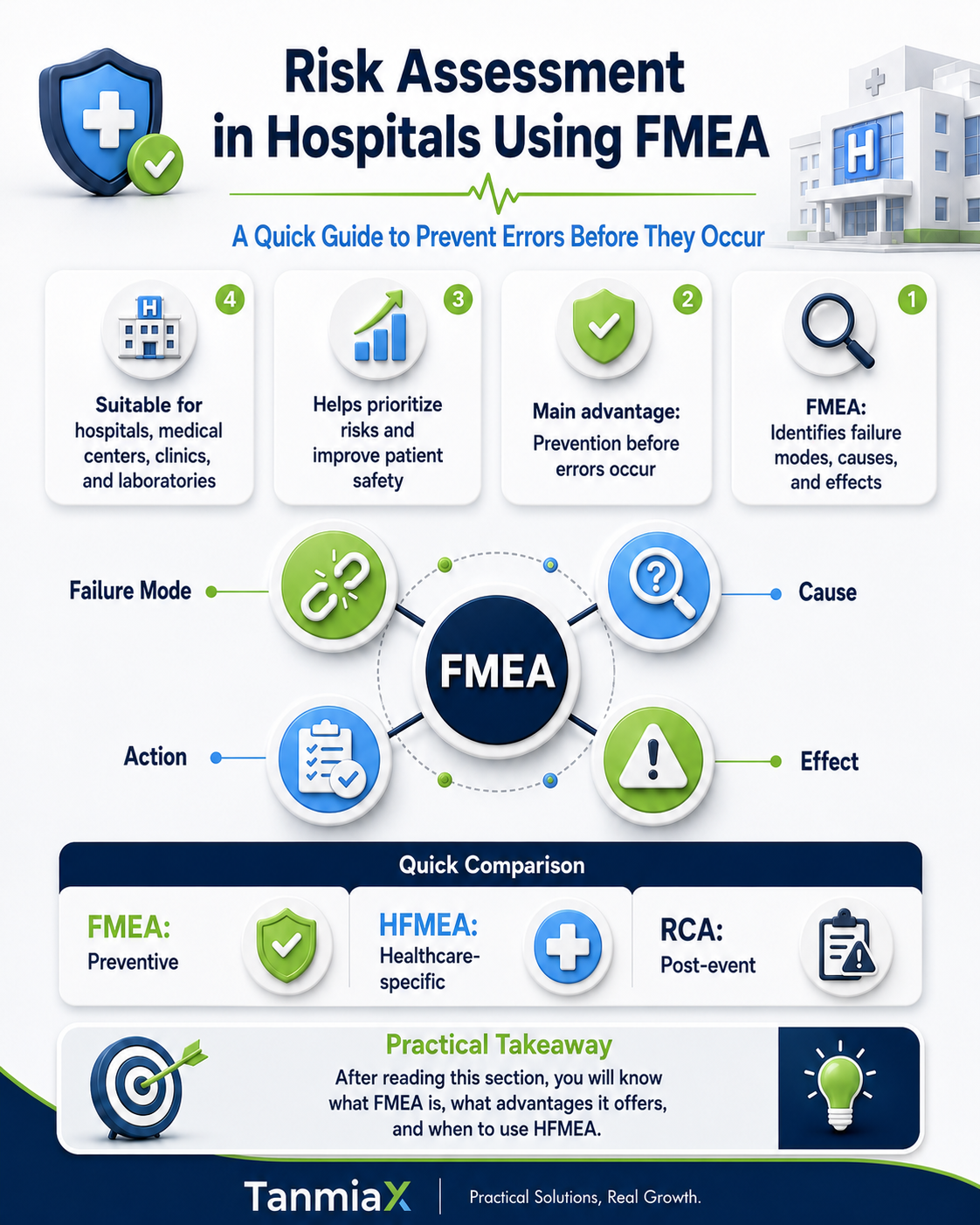
A clinical process may look simple on paper, yet in practice it can involve multiple professionals, software systems, devices, policies, handoffs, and decision points. A laboratory blood-draw process, for example, includes patient identification, order entry, tube selection, specimen collection, labeling, transportation, laboratory reception, analysis, and result reporting. Every step can contain a potential failure mode.
Many of these vulnerabilities remain hidden until an incident or near miss occurs. A hospital FMEA risk assessment changes this logic. Instead of waiting for harm and then investigating what happened, the team asks in advance how each process step could fail, what the effect could be, why it could happen, and which controls would meaningfully reduce the risk.
FMEA is a structured, team-based method for identifying potential failure modes, examining their effects and causes, and prioritizing risk-reduction work. For additional methodological detail, review the VA National Center for Patient Safety HFMEA resources and the ASQ FMEA overview.
What is FMEA, and why does it matter in healthcare?
FMEA stands for Failure Mode and Effects Analysis. It is a proactive method that examines a process step by step to identify how it could fail before the failure causes harm, delay, rework, waste, or service disruption.
What could go wrong?
The team identifies possible failure modes at each step of the process.
What would the effect be?
The impact on patients, staff, equipment, information, and operations is considered.
What should change?
The team selects controls, assigns ownership, and defines measures to verify improvement.
A failure mode is not the same as a cause
“Medication sent for the wrong patient” is a failure mode. Similar patient names, absence of a second identifier, a poorly designed user interface, interruptions during preparation, or multiple records open at once may be causes. This distinction matters because an effective action should address the cause, not merely restate the visible error.
Examples of medication-process failure modes
- The wrong medication is selected.
- An incorrect dose is entered.
- A documented allergy is missed.
- An order is transmitted late.
- Medication is prepared for the wrong patient.
The proactive mindset
FMEA does not require the organization to wait for an adverse event. It creates a controlled way to examine vulnerability before a failure reaches the patient or disrupts the service.
What is the difference between FMEA, HFMEA, and RCA?
These terms are sometimes used interchangeably, but their starting point and intended use are different.
General and proactive
Starts with a process, design, or system and asks what might fail in the future.
Adapted for healthcare
Combines healthcare-focused severity and probability scoring with a hazard matrix and decision tree.
Usually event-driven
Starts after an incident or near miss and asks why it happened and how recurrence can be prevented.
Benefits of hospital FMEA risk assessment
Prevention before harm
High-risk process weaknesses can be addressed before they become adverse events.
A shared view of the process
Clinical, operational, technical, and administrative teams align around the same workflow.
Better prioritization
Limited resources are directed toward risks with greater severity, frequency, or control weakness.
Clearer decisions
Scope, failure mode, cause, effect, score, action, owner, and KPI are explicitly documented.
Frontline participation
Workarounds and real-world details that do not appear in procedures become visible.
Measurable improvement
Corrective actions are connected to baselines, targets, balanced measures, and reassessment.
Process mapping during FMEA also reveals where information is generated, where it is handed off, who owns each step, which steps are manual, where duplication occurs, and where performance depends too heavily on memory or individual attention.
Types of FMEA and the most useful method for hospitals
System or Functional FMEA
Examines a system at a high level—for example patient transfer, medication management, emergency response, incident reporting, or medical-equipment management.
Design FMEA
Assesses risk in a new unit, digital form, device interface, physical layout, software workflow, or service before implementation.
Process FMEA
Focuses on operational steps such as admission, specimen collection, blood transfusion, handover, discharge, sterilization, or high-alert medication management.
HFMEA
Adapts FMEA for healthcare and is often the most practical starting point for patient-safety and clinical-process analysis.
Recommended method by problem type
| Problem or objective | Recommended method | Why |
|---|---|---|
| Clinical workflow and patient safety | HFMEA | Healthcare-oriented hazard scoring and decision logic |
| Equipment failure and maintenance | Process FMEA or FMECA | Stronger focus on failure mechanisms, criticality, and technical controls |
| New software, form, device, or department | Design FMEA | Identifies risk before deployment or commissioning |
| An incident that has already occurred | RCA | Investigates contributing and root causes after the event |
| Dependencies across multiple departments | System FMEA | Provides a broader view of interfaces and handoffs |
In classical FMEA, risk priority is often considered through severity, occurrence, and detectability; some approaches multiply these scores to calculate an RPN. In commonly used HFMEA approaches, severity and probability create a hazard score, while detectability and existing controls are considered through decision-tree logic.
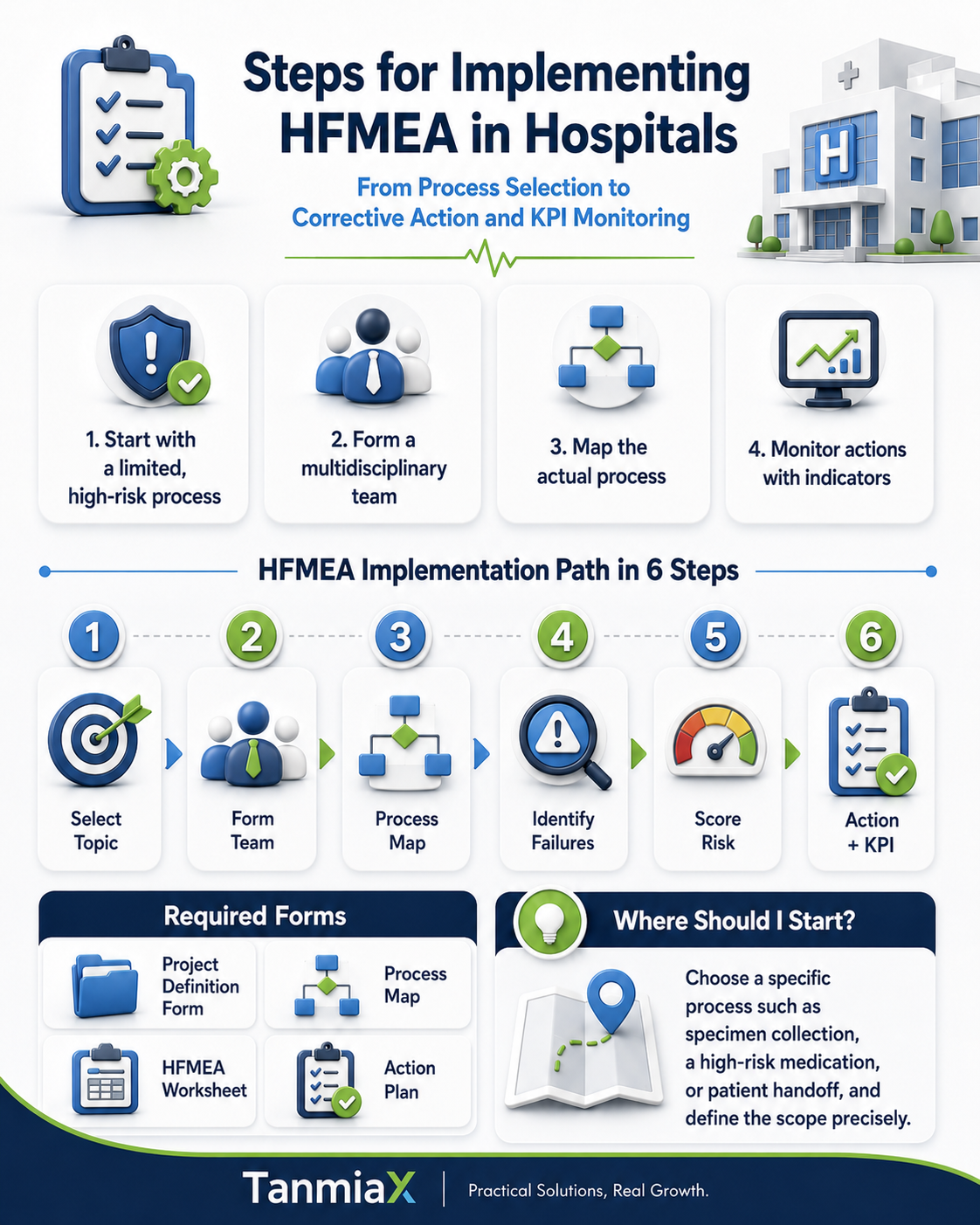
How to start FMEA in a hospital: a practical HFMEA workflow
The quality of the project depends heavily on scope. “Review the medication process in the hospital” is too broad. A more useful scope might be “registration, preparation, delivery, and receipt confirmation of high-alert medications during the night shift in the intensive care unit.”
Select the topic
Choose a defined, high-risk, measurable, and improvable process.
Build the team
Include process owners, frontline staff, quality, and relevant technical experts.
Map the process
Document what really happens across shifts and under pressure—not only the official procedure.
Identify failures
Define failure modes, effects, causes, and current controls at each step.
Prioritize risk
Apply agreed severity, probability, and decision-tree definitions.
Act and measure
Assign owners, deadlines, outcome KPIs, and a reassessment date.
Step 1: Select and narrow the topic
Good topics often come from repeated incidents and near misses, patient complaints, audit findings, new technology, service redesign, multiple handoffs, reliance on memory, high-severity hazards, negative KPI trends, or concerns raised by frontline staff.
Step 2: Build a multidisciplinary team
FMEA should not be completed by the quality department alone. Quality professionals facilitate the method, but the actual process knowledge comes from owners and frontline staff.
Clinical members
Relevant physician, nurse, technologist, pharmacist, laboratory professional, or other frontline expert.
Quality and leadership
Quality manager, patient-safety lead, project sponsor, and a decision-maker who can remove barriers.
Technical and support roles
Information technology, biomedical engineering, infection prevention, reception, logistics, or facilities as required.
Step 3: Map the real process
The process map should not be based only on the approved procedure. Direct observation, interviews, software walkthroughs, form reviews, incident reports, and delay data help the team understand what happens during busy periods, night shifts, system downtime, and unusual patient conditions.
- The test order is entered.
- The patient’s identity is verified.
- The correct tube is selected.
- The specimen is collected.
- The label is printed and applied.
- The specimen is transported and received by the laboratory.
Step 4: Identify failure modes, effects, and causes
At each step ask: “In what ways could this step fail to produce the intended result?” During patient identification, examples may include checking only one identifier, absence of a wristband, unreadable information, another patient’s record remaining open, or relying on a family member without following the approved identification process.
Useful cause-analysis tools include the five whys, fishbone analysis, structured brainstorming, human-factors review, interface review, workload analysis, interruption analysis, and physical-environment assessment.
Step 5: Score and prioritize risk
In a commonly used HFMEA structure, severity and probability are rated from 1 to 4:
Educational example: severity 4 × probability 3 = hazard score 12 out of 16.
The team then considers whether the hazard score meets the action threshold, whether the item is a single-point weakness, whether an effective control already exists, whether the failure is likely to be detected before harm, and whether the analysis should continue. A score supports judgment; it should not replace professional judgment.
Step 6: Define corrective actions and monitoring
For every priority risk, document the target cause, action type, action description, owner, due date, required resources, baseline, target, reporting frequency, approval authority, and reassessment date. HFMEA actions generally fall into three broad categories: eliminate the hazard, control the hazard, or formally accept the residual risk with documented rationale and review.
Learning-stage CTA: begin with one process
Before buying software or creating a large committee, select one high-risk process and map its real workflow on a single page. Use the checklist in this article as the agenda for the first team meeting.
Which forms are needed for FMEA or HFMEA?
A useful documentation package should support the project from scope definition through risk reassessment. More forms do not automatically produce a better analysis; each form should support a clear decision or stage.
1. Project charter
Project title, reason for selection, process boundaries, departments, objective, start date, and executive sponsor.
2. Team record
Name, role, department, project responsibility, contact details, and meeting participation.
3. Process map
Main process, subprocesses, decision points, information handoffs, systems, and responsible roles.
4. FMEA/HFMEA worksheet
Step, failure mode, effect, cause, severity, probability, control, score, decision, action, owner, KPI, and due date.
5. Severity and probability guides
Standard definitions that reduce variation in scoring between team members.
6. Hazard matrix and decision tree
Supports prioritization while considering control strength, detectability, and single-point vulnerability.
7. Action plan
Action, accountable owner, budget, timeline, dependencies, evidence, and status.
8. KPI and reassessment record
Baseline, target, reporting frequency, outcome, residual risk, and next review date.
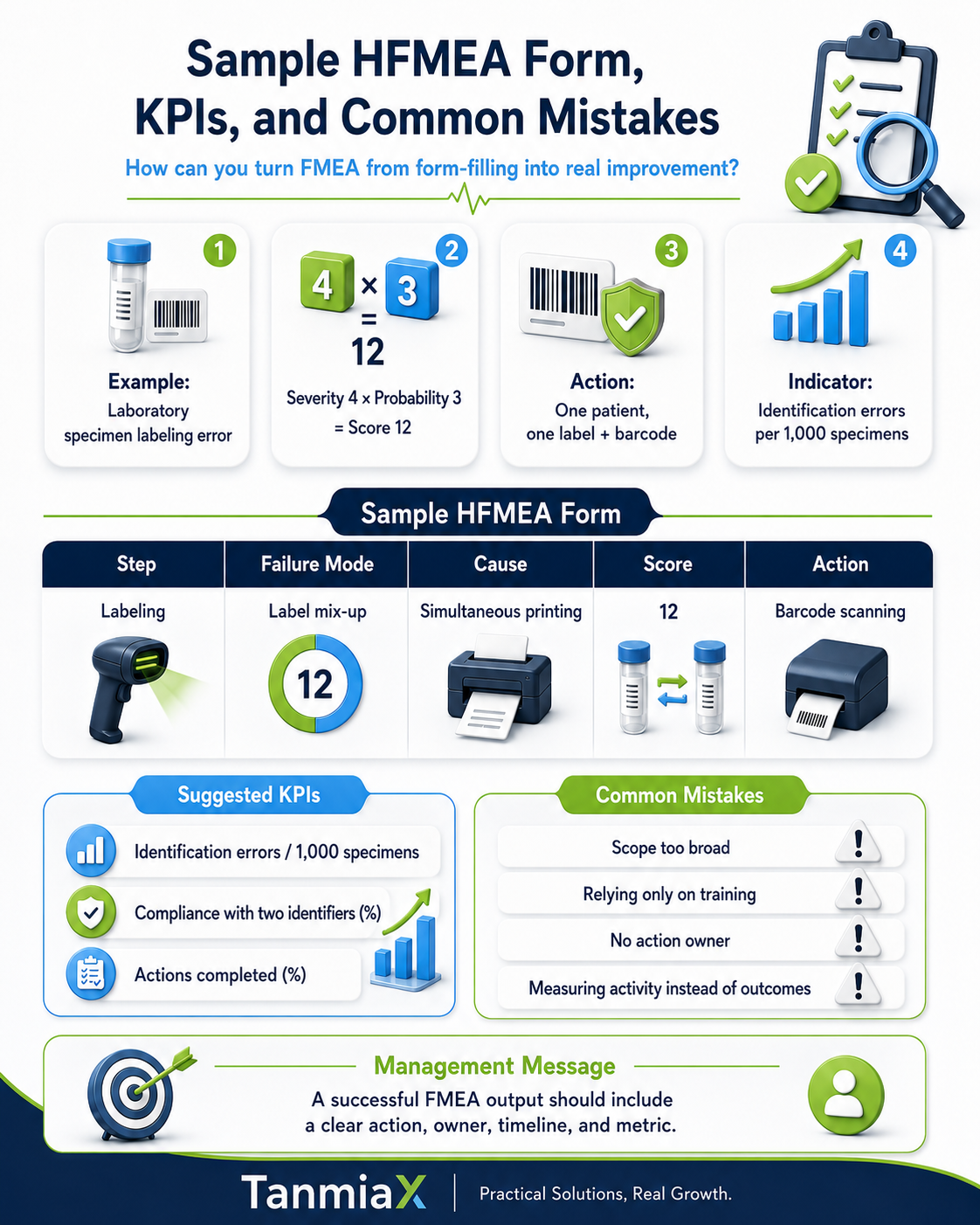
Completed hospital HFMEA example: specimen-labeling risk
This educational example examines outpatient blood collection and the subprocess “print and apply the specimen label after collection.”
Failure mode
Another patient’s label is applied to the specimen tube.
Potential effect
A result may be assigned to the wrong patient, causing recollection, delay, rework, and unsafe clinical decisions.
Potential causes
Batch printing, interruptions, shared label areas, failure to use two identifiers, or no barcode connection to the LIS.
Example score
Severity 4 × probability 3 = hazard score 12 out of 16, requiring continued analysis and action.
| Field | Completed example |
|---|---|
| Main process | Outpatient laboratory blood collection |
| Subprocess | Printing and applying the specimen label |
| Process step | Apply the label immediately after specimen collection |
| Failure mode | Another patient’s label is applied to the specimen tube. |
| Failure effect | Incorrect patient-result assignment, delay, recollection, rework, and potential clinical decisions based on wrong information |
| Cause 1 | Labels for multiple patients are printed at the same time. |
| Cause 2 | Labeling occurs away from the patient. |
| Cause 3 | Scanning the patient identifier and tube is not mandatory. |
| Current control | Policy requiring visual verification of name and medical record number |
| Example severity | 4, because a serious patient consequence is possible |
| Example probability | 3, based on the team’s preliminary assessment of occasional occurrence |
| Hazard score | 12 out of 16 |
| Single-point weakness | Yes; the error could continue into later stages without another reliable barrier. |
| Is the current control effective? | No; it depends mainly on attention and memory. |
| Is detection highly reliable? | No; the mismatch may remain hidden until after analysis or reporting. |
| HFMEA decision | Continue the analysis and define risk-reduction actions. |
| Action type | Eliminate and control |
| Action 1 | Stop batch label printing and apply a “one patient, one transaction” rule. |
| Action 2 | Print the label only after two identifiers are confirmed. |
| Action 3 | Connect patient and tube barcode scanning to the LIS. |
| Action 4 | Redesign the collection area so each patient’s record and labels remain physically separated. |
| Primary owner | Laboratory manager with information technology and quality support |
| Outcome KPI | Number of specimen identification mismatches per 1,000 specimens |
| Process KPI | Percentage of specimens labeled in the patient’s presence after two-identifier verification |
| Balancing KPI | Average collection time and patient waiting time |
| Example target | At least a 50% reduction from baseline during the first three months |
| Monitoring frequency | Weekly during month one, then monthly for the next three months |
| Reassessment date | Three months after full implementation |
| Residual risk | To be determined after implementation data and rescoring are available |
How to choose stronger corrective actions
A common failure in FMEA programs is to use “retrain staff” as the primary action for almost every risk. Training may be necessary, but it is rarely a strong standalone control when the process still depends on memory, attention, or an individual choosing correctly under pressure.
Stronger actions
- Remove an unnecessary step or the opportunity for error
- Use an interlock or hard software constraint
- Use barcode verification and automatic data transfer
- Standardize equipment and separate look-alike items
- Simplify the process and reduce handoffs
Intermediate actions
- Structured checklist or read-back
- Targeted redundancy
- User-interface improvement
- Interruption reduction and better documentation
Usually weaker as standalone controls
- General training
- A new policy without system redesign
- A warning sign that can be ignored
- Manual double-checks dependent on human attention
KPIs for monitoring FMEA results
A KPI should demonstrate that risk has actually decreased—not merely that an activity occurred. “100% of staff completed training” confirms training completion, but it does not show that identification errors became less likely.
Weak measure
Percentage of employees who completed the training session.
Outcome-focused measure
Rate of specimen identification mismatches per 1,000 specimens.
Suggested KPIs for the specimen-labeling example
- Labeling errors per 1,000 specimens
- Compliance with two-identifier verification
- Percentage of specimens labeled in the patient’s presence
- Near misses detected before analysis
- Successful barcode-scan rate
- Specimen recollections caused by process errors
- Average collection and waiting time as balancing measures
- Percentage of FMEA actions completed on time
Define each KPI before reporting it
Definition
Numerator, denominator, unit, inclusion rules, and exclusions.
Benchmark
Baseline, target, warning threshold, and review period.
Accountability
Data source, owner, validation method, and reporting frequency.
Analysis
Breakdown by unit, shift, patient group, or location and the response to threshold breaches.
Common mistakes in hospital FMEA projects
Choosing a scope that is too broad
“Hospital FMEA” or even “the medication process” is usually too large to manage effectively.
Quality staff complete the worksheet alone
Without frontline participation, the analysis reflects written policy more than real work.
Scoring before mapping the process
Failure modes become incomplete, duplicated, or disconnected from the agreed scope.
Confusing the failure mode with the cause
“Staff carelessness” is not measurable and rarely leads to a strong system action.
Scoring from opinion when data exist
Incident reports, complaints, audit results, system logs, and rework data should be reviewed.
Overreliance on RPN or one score
High severity, single-point weakness, or absence of reliable controls may deserve attention regardless of the total score.
Training is the only action
Training without redesigning software, workflow, environment, or workload rarely produces durable control.
No named action owner or deadline
“The responsible department will take action” is not sufficient for accountability.
Measuring activity instead of outcome
The number of meetings, forms, or training sessions does not prove that risk decreased.
No balancing measure or reassessment
An action may reduce errors but unintentionally increase waiting time, workload, or new risks.
A six-week hospital FMEA implementation roadmap
Define the project
- Select the process
- Set the sponsor and objective
- Collect initial data
- Confirm the team and meetings
Observe and map
- Observe several shifts
- Interview staff
- Review procedures and systems
- Validate the process map
Identify failure modes and causes
- Structured brainstorming
- Document effects and causes
- Remove duplicates
- Review human and digital factors
Score and prioritize
- Severity and probability
- Hazard score
- Decision-tree review
- Select risks requiring action
Design actions and KPIs
- Choose stronger controls
- Set owners, resources, and dates
- Define outcome and balancing KPIs
- Obtain leadership approval
Pilot, monitor, and expand
- Run a controlled pilot
- Check unintended effects
- Build reporting and reassess risk
- Scale and capture lessons learned
This is an illustrative schedule. A narrow project may move faster, while a cross-departmental project or one that requires software integration may take longer.
Dashboards, automation, and AI in healthcare risk management
FMEA is fundamentally a management and team method. Software cannot replace direct observation, process knowledge, professional judgment, or multidisciplinary discussion. Technology becomes valuable when it makes the resulting risk actions visible, traceable, measurable, and sustainable.
Risk dashboard
Displays open risks, high-severity hazards, overdue actions, action owners, KPI trends, near misses, reassessment status, and residual risk.
Workflow automation
Assigns actions, sends reminders, stores evidence, routes approvals, and returns risks for scheduled review.
Data integration and analytics
Connects data from Excel, incident systems, HIS, LIS, maintenance systems, and operational reports to reveal patterns.
Integrated analysis can reveal a higher error rate on one shift, a relationship between workload and incidents, a connection between equipment downtime and service delay, repeated near misses at the same handoff, or unintended effects of a corrective action. Capacity and staffing issues can also be explored through demand forecasting and resource optimization.
AI can help classify narrative reports, identify repeated themes, and suggest items for expert review. However, final decisions about severity, cause, control effectiveness, and action must remain with qualified professionals. Patient information must also be handled under the organization’s privacy, security, and access-control policies.
Consideration-stage CTA: are your FMEA actions scattered?
If risk actions are spread across Excel files, meeting minutes, and disconnected systems, first assess the data flow, accountability model, and KPIs. A focused dashboard and workflow can make open risks and overdue actions visible without replacing your current clinical systems.
Hospital FMEA risk assessment: key takeaways
A hospital FMEA risk assessment creates value only when it moves beyond scoring a worksheet and leads to process redesign, accountable actions, and outcome monitoring.
You do not need to analyze the whole hospital at once. Select one clearly bounded, high-risk, measurable process. Build a multidisciplinary team, map the actual workflow, identify failure modes and causes, and prioritize risk through a consistent method.
HFMEA is often the most practical choice for clinical and patient-safety processes because it combines severity and probability with decision-tree questions about controls, detectability, and single-point weaknesses. The initial score matters, but the quality of the action and the monitoring plan matter more.
If the output is only a completed worksheet, FMEA becomes an administrative exercise. When actions feed into workflow, management dashboards, quality meetings, and operating decisions, FMEA can become part of a living healthcare risk-management system.
Hospital FMEA implementation checklist
Project definition
- The topic is clearly defined and limited.
- The beginning and end of the process are stated.
- The reason for selecting the process is documented.
- An executive or operational sponsor is named.
- The project objective is measurable.
Team formation
- Key process owners are represented.
- Frontline staff participate.
- Quality or patient safety facilitates the method.
- IT or biomedical expertise is included when needed.
- A recorder and version-control owner are assigned.
Process understanding
- The real process has been observed.
- Differences between policy and practice are examined.
- Multiple shifts or operating conditions are considered.
- Process owners validate the map.
- Information handoffs and responsibilities are visible.
Risk analysis
- Failure modes are recorded for each relevant step.
- Effects and causes are distinguished.
- Incident and near-miss data are reviewed.
- Severity and probability definitions are consistent.
- Decision-tree reasoning is documented.
- Reasons for stopping analysis are recorded.
Corrective action
- The action is linked to a specific cause.
- System controls are preferred over training alone.
- Each action has one named accountable owner.
- A target completion date is defined.
- Resources and dependencies are identified.
- Required approvals are obtained.
Monitoring and reassessment
- A baseline is available.
- KPI definitions include numerator and denominator.
- Outcome and balancing measures are included.
- Reporting frequency and ownership are clear.
- A reassessment date is scheduled.
- Residual risk will be rescored after implementation.
Three practical next steps
If you are learning and starting internally
Select one limited process, map the real workflow, and use this checklist as the agenda for your first HFMEA meeting.
Review the Six StepsIf you are evaluating a solution
Assess your data, process ownership, reporting gaps, and readiness before investing in a dashboard or workflow tool.
Start the Free AssessmentIf you are ready to explore a pilot
Review how FMEA actions could be converted into a risk dashboard, accountable workflow, automated reminders, and measurable reporting.
Frequently asked questions about FMEA in hospitals
What is FMEA in a hospital?
FMEA is a proactive, team-based method for identifying how hospital processes could fail, what the consequences could be, why the failure might occur, and which controls could reduce the likelihood or impact.
What is the difference between FMEA and HFMEA?
FMEA is the general method. HFMEA is adapted for healthcare and commonly uses a healthcare-focused severity and probability matrix plus decision-tree questions about single-point weaknesses, current controls, and detectability.
Do we need special software to run HFMEA?
No. A limited project can begin with a structured worksheet, spreadsheet, and process-mapping tool. Software becomes more valuable when the organization has many projects, actions, departments, KPIs, approvals, reminders, or data integrations.
How is RPN calculated?
In many classical FMEA models, RPN is calculated by multiplying severity, occurrence, and detectability. In commonly used HFMEA approaches, severity and probability create a hazard score, while detectability is evaluated through decision-tree logic.
Which process should we choose for the first FMEA?
Select a process that is high-risk, clearly bounded, measurable, and realistically improvable. Patient identification, specimen collection, high-alert medication handling, patient handoff, transport, or admission can be suitable when the scope is specific.
How many people should be on the FMEA team?
There is no single required number. The team must represent the key roles in the process without becoming too large to make decisions. Frontline staff, the process owner, quality or patient safety, and relevant technical specialists are usually more important than the total headcount.
How often should FMEA be reviewed?
Review it after action implementation, process redesign, software or equipment changes, a negative KPI trend, or a related incident. Organizations may also establish periodic review intervals based on residual risk.
Is staff training an adequate corrective action?
Training may be necessary, but it is rarely sufficient by itself. Elimination, standardization, barcode verification, software constraints, automatic data transfer, and environmental redesign generally provide stronger and more durable controls.
Is FMEA only for clinical risks?
No. It can also be applied to administrative workflows, information technology, medical equipment, maintenance, logistics, infection-prevention support processes, supply chains, cybersecurity, waste management, and business continuity.
Can AI perform FMEA automatically?
AI can help classify reports, identify recurring patterns, and suggest areas for expert review. It cannot replace multidisciplinary process knowledge, direct observation, clinical judgment, governance, or formal approval of risk scores and actions.